

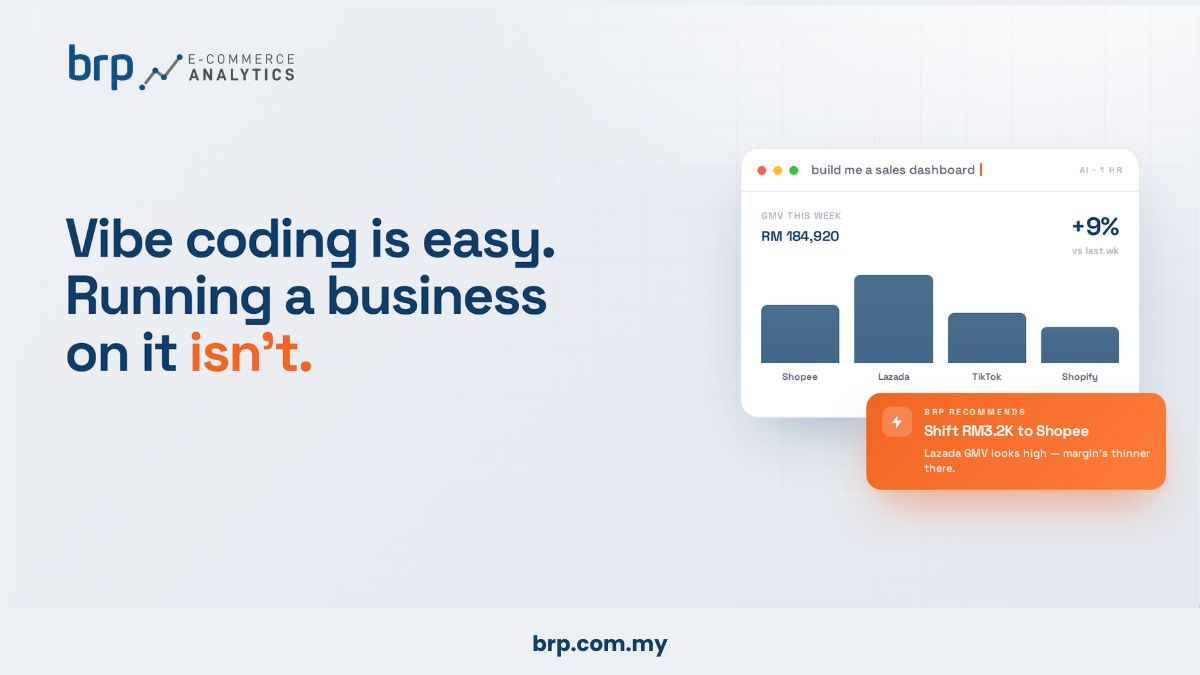
Over just the past few weeks, vibe coding and AI have been all the rage.
More people have been building their own tools. And citing the death of SaaS platforms.
Why AI-generated tools aren’t a substitute
There’s a conversation happening right now in every e-commerce team, agency, and startup: “Do we really need this tool? Can’t we just build it ourselves with AI?”
Fair question.
With today’s AI coding assistants, spinning up a dashboard, a simple data automation workflow, or a reporting tool takes hours, not months. The barrier to entry has never been lower. And yes, a lot of businesses are doing exactly that.
Well, the BRP Analytics team has been fiddling with Claude to speed up our development process.
But here’s what I’ve noticed after working closely with marketplace sellers across Shopee, Lazada, and TikTok Shop: building a tool and running a business are two completely different problems.
“The real bottleneck was never code. It was knowing which numbers to watch, and what to do when they move.”
1. Vibe coding ships fast. Maintenance ships slow (if at all)
The appeal of AI-generated code is real. You can describe a problem, iterate quickly, and have something working in an afternoon. But every system that gets built eventually needs to be maintained, updated, and understood by someone other than the person who built it.
In practice, what gets created is often a black box. The original developer moves on. The logic that made sense in Week 1 becomes mysterious in Month 6.
Marketplace APIs change all the time. Data formats shift. And suddenly, the “custom system” no one fully understands becomes a liability instead of an asset.
From experience, fast-growing e-commerce players don’t want to manage infrastructure. They also cannot revalidate outputs again and again. What they truly want is simply results. Therefore, the overhead of owning a custom system, which comes with bug fixes, API updates, and edge cases, is not their core focus.
It shouldn’t be.
2. AI executes. Domain knowledge decides.
Knowing how to build an analytics tool is easy with AI.
But knowing what to build: which metrics matter, which signals predict growth, what a healthy sell-through rate looks like in your category is something else entirely.
Domain knowledge isn’t just about knowing the terminology. It’s about having seen enough situations to know what questions to ask before a problem surfaces. It’s the difference between a dashboard that shows you data and one that shows you the right data at the right moment.
AI is a powerful execution tool. But value creation, the kind that actually moves GMV, improves inventory decisions, or surfaces a hidden opportunity in your product catalogue, requires judgment that comes from experience.
3. Our goal isn’t to be a tool. It’s to be your partner.
This is our deliberate choice at BRP. We’re not trying to be the cheapest analytics tool or the most customisable dashboard builder. We’re trying to be the team that helps you understand your business and make better decisions with that understanding.
That means going beyond reporting.
It means proactive recommendations:
- Why did your conversion drop last week?
- Where your ad spend is underperforming.
- Which SKUs to push in the coming peak period?
These are the kind of insights that take context, pattern recognition, and marketplace-specific knowledge to produce.
Think of it less like a SaaS subscription and more like having an embedded data partner. One that knows the Malaysian marketplace dynamics, understands the nuances of platform algorithms, and is invested in your growth.
Any team can vibe-code a dashboard. But not every team knows what to do after the numbers come in.
That’s where we come in and that’s the part that doesn’t get replaced.

Leave A Comment